I first got the idea for this piece around this time last year. It came while I was watching Netflix, specifically an episode of a police procedural show called The Rookie.
 The scene of the crime. I cannot in good conscience recommend this show to you because it's not super great quality, but it's unfortunately extremely addictive.
So one night last July, I'm ashamed to say, I was several seasons into this show. In the particular episode I was watching that night, one of the main characters was having a bit of a disagreement with her husband. She wanted to explain to him why she was so frustrated with his behavior, and she started her sentence with "Here's the thing."
Here's the thing. Just three words. But because of those three words, I paused the show and immediately thought: this sounds like it was written by AI. Of course the first thing I checked was the episode's release date: 2022. So it was likely written and filmed in 2021. ChatGPT launched at the end of November 2022. Given how obscure this technology was to the public before ChatGPT, I concluded it was unlikely this line was written by AI.
But it still left me with these questions, which I have spent the last year trying to answer:
- To what extent can AI convincingly imitate human writing style?
- What are the consequences of AI-generated content, convincingly human or otherwise, flooding our communication spaces?
- How do we respond to this phenomenon so we end up in the future of our choosing instead of one that happens to us?
This piece will explore the first two questions. My thoughts on the third are coming next week.
A note on terminology
In this piece I will use AI to refer to large language models (LLMs), the technology behind tools like ChatGPT. An LLM is a computer program trained on enormous amounts of text, which produces language by predicting, one word at a time, what is most likely to come next. Hence the designation GPT: generative (it produces text), pre-trained (it learned from all that text first), transformer (the kind of program doing it).
When I mean another kind of AI, I'll say so, such as the recommendation algorithms that decide what Netflix serves you next, which you can thank for my Rookie habit.
Question 1: To what extent can AI convincingly imitate human writing style?
But first, what is style?
Before you can ask whether a machine can copy your style, you have to say what style is. I see this in two parts: one part is conscious. It's the rules you'd put in a style guide, including the word choices you prefer, how you open, what kinds of sentences you reach for, what you'd never write. For example, ever since my Ph.D. advisor pointed out that my use of "illustrative example" was redundant (because an example is, by nature, illustrative), I've had a strong distaste for this type of redundancy. That rule now lives in my own style guide.
The second part of style is unconscious, but still measurable.
To understand these unconscious markers, we turn to stylometry. Stylometry is the study of a writer's unique linguistic fingerprint. It measures things like word choice, sentence length, and punctuation habits and is often used to determine authorship: was a document really written by the person who claims to have written it? Or conversely: who wrote this unknown document?
Stylometry shows us that the words authors think about only subconsciously often have the greatest effect on their style: pronouns, conjunctions, or articles. It seems that when we write we think a lot about the main words in a sentence: subject, object, verb, and choose all the other words without thinking too much about it. And those unconscious choices are often what make our writing style distinctive from others.
We have a working definition of style with two measurable layers: the explicit rules we choose to follow, and the unconscious markers we leave behind. The next question: can AI reliably follow our rules and stylometric markers?
So close...
Early research says yes, given the right approach. Researchers successfully had several LLMs match an author's style (measured by looking at stylometric markers) by showing it several examples of someone's writing, or asking it to continue a half-finished human text. On the measures stylometry has trusted for decades, the models are acing the exam.
...but no cigar
And yet, there is still something missing. In their book Me, My Customer, and AI, Henrik Werdelin and Nicholas Thorne admit that they tried desperately to have AI write their book. They had good ideas, detailed outlines, style rules and examples of how they wanted the AI to write, but they found that "2 and 2 consistently came back as 1.5". No matter how precisely or thoughtfully they prompted an LLM to write their book, they were never quite satisfied with the results.
Both of us predict. One of us surprises.
A language model, remember, produces text by predicting what word is most likely to come next based on what came before it. That sounds contrary to the way humans think... except it's not.
We humans also anticipate what word comes next in a sentence based on what, in our experience, is most likely to come next. We like the way certain words sound together, so we often use them together; that's why there are whole dictionaries of word pairings, collocations like "fast food," "heavy rain". "Speedy food" and "hefty rain" just don't sound right.
Eight-month-old babies already track which syllables tend to follow which (it's how they find the word boundaries in speech). And it's one reason learning a new language is so hard: beyond the vocabulary and the grammar, you're rebuilding your entire prediction engine.
Despite also being prediction machines, we humans still thrive on unpredictability. Human writing is roughly twice as unpredictable as AI text matched to the same style. AI detection tools call this perplexity, and it's the most reliable tell they have. Human writers do surprising things that LLMs do not, and their readers enjoy this surprise.
Question 2: What are the consequences of AI-generated content, convincingly human or otherwise, flooding our communication spaces?
Now let's zoom out. The normal cadence of human communication is that society shapes how we write, and writing styles spread from writer to writer. This is how we end up with cultural literary movements. The internet and social media have already sped up this cycle considerably.
And now AI has joined the chat and is moving it at hyper speed. Society shapes our writing; our writing trains the AI; the AI shapes our writing again. And because AI works on probability, the more repetitive content we feed into its training set, the more repetitive content comes out. We are reinfecting ourselves. And so the cycle continues.
We are already seeing the early signs. Researchers tracking scientific writing found AI's favorite words — delve, meticulous, intricate — surging after ChatGPT arrived; at least 13.5% of 2024's medical research papers show signs of AI's touch in their summaries.
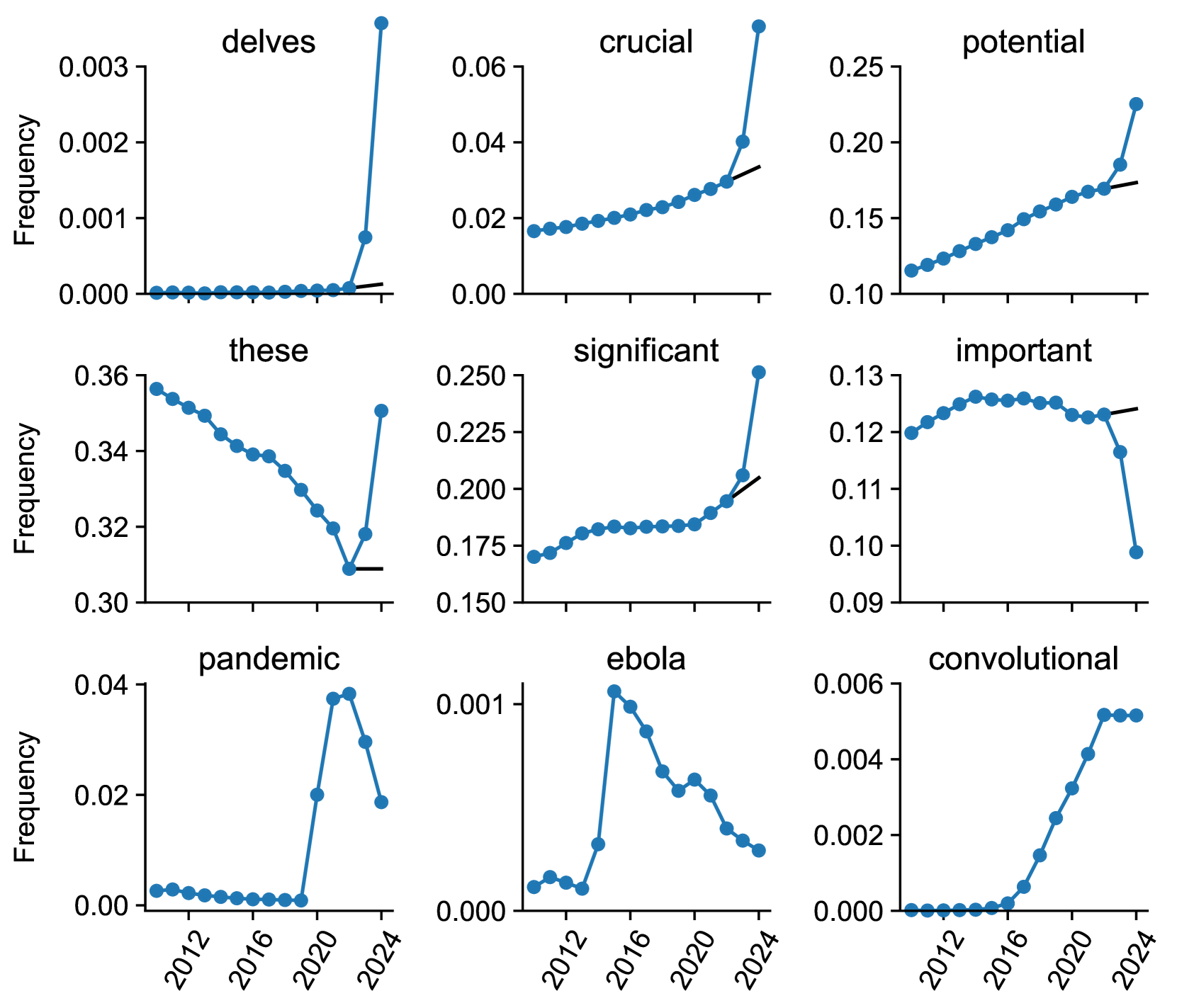 AI's favorite words arriving in scientific writing, measured across 15 million PubMed abstracts. The black lines show where each trend was heading before ChatGPT. From a 2025 study in Science Advances led by Dmitry Kobak.
The same vocabulary is now rising in how we speak, measured across hundreds of thousands of podcast episodes and recorded talks.
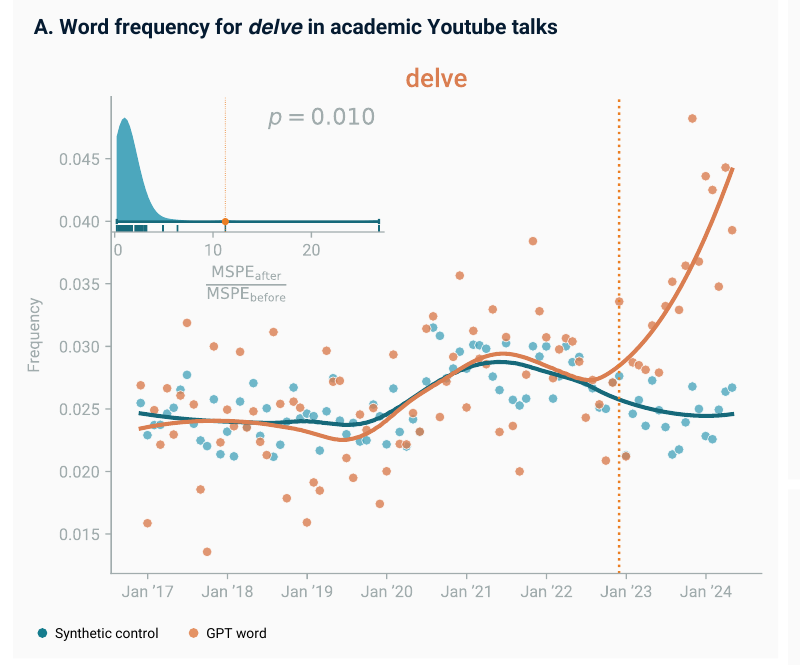 "Delve" climbing in spoken language after ChatGPT's release (orange, panel A), against a comparison line showing where the trend was heading anyway (blue). Based on analysis of podcasts and academic talks on YouTube. From Yakura and colleagues, 2024, Figure 2.
And as for a conclusion, I couldn't put it better than the researchers put it themselves:
"These findings suggest a scenario where machines, originally trained on human data and subsequently exhibiting their own cultural traits, can, in turn, measurably reshape human culture. This marks the beginning of a closed cultural feedback loop in which cultural traits circulate bidirectionally between humans and machines. Our results motivate further research into the evolution of human-machine culture, and raise concerns over the erosion of linguistic and cultural diversity, and the risks of scalable manipulation."
We have taught the machines to talk like us, and now they're teaching us to talk like them. And the AI voice is not a neutral voice. AI detectors falsely flag non-native English speakers as AI: in one 2023 study, 61% of essays by non-native speakers were flagged as AI-generated, compared to roughly 5% for native speakers. And AI writing suggestions nudge non-Western writers toward Western style, stripping out cultural nuance along the way. The research is young and almost entirely about English — nobody has measured what the same loop is doing to other languages yet. But the early pattern points one direction: toward one voice. And it isn't everyone's.
The slow practice
The newest, most capable AI models are improving exponentially. As they do, they will get better and better at imitating individual writing styles. If we are not careful, the AI-ification of our language will start to define us, instead of the other way around. The early signs are the ones I just showed you: the delves curve breaking away from its trend line in scientific writing, and the same word climbing in recorded talks.
The very first thing I always highlight when talking about writing with AI: far too much attention is given to AI's ability to write. What we should be focused on is AI's ability to read — and, even more, our own. Writing with AI does not have to mean that AI is doing the writing.
Today, when I teach professionals how to write with AI, they are often surprised at the content of my courses. I think they are expecting me to give them magic prompting techniques that will turn ChatGPT into a prize-winning marketing specialist. I also think they are expecting that writing with AI will be easy. But instead, I throw them into a practice of reading closely. The next task after that is documenting precisely. They are forced to think about writing and communication in a way they never have before. There are so many innate decisions they make when they write and when they review their own or others' writing. We need to surface those before we even think about employing the help of a large language model. And finally, my classes end with AI as a writing copilot, not a ghostwriter.
When I work with AI myself, I offload rote tasks to it and expect it to keep me faithful to my own rules. This is all so I can be slow and meticulous. (And yes, it was me who picked the word "meticulous" there, not AI.)
I can't help myself but let Friedrich Nietzsche have the last word. In his 1881 book Daybreak he called himself a teacher of slow reading, writing "in the midst of an age of 'work,' of indecent and perspiring haste." In fact, we are living in an age of indecent and perspiring haste beyond anything Nietzsche could have imagined. And we can choose to meet it in the same way as Nietzsche: "to read slowly, deeply, looking cautiously before and aft, with reservations, with doors left open, with delicate eyes and fingers."
This is part 1 of a two-part series. Part 2, "We choose what comes next," publishes next week. The short version of this argument — and the comments that convinced me to write the long one — is here.